
How to build SaaS products with Generative AI in 2026?

Dasher

How to Build SaaS 2.0 Products With Generative AI in 2026 That Still Remain Relevant
In 2026, SaaS is not dead, but a lot of traditional SaaS assumptions are under real pressure. Agentic AI, embedded assistants, and AI-first product design are changing what customers expect software to do. Deloitte’s 2026 software outlook says agentic AI adoption and the shift to AI-first products are intensifying competition and forcing new approaches for software companies, while Gartner says task-specific AI agents are rapidly moving into enterprise apps.
The important distinction is this: software is still valuable, but software that only exposes information, organizes work, or sells access to a UI is more fragile than it used to be. The opportunity now is to build what you could call SaaS 2.0: products that own outcomes, execute workflows, embed intelligence deeply, and connect tightly to real business systems. Pricing is shifting too, because AI changes cost structure and value delivery. McKinsey notes that AI introduces variable costs that push software away from older pricing models and more toward consumption, while Simon-Kucher argues that traditional seat and license metrics break down once AI starts replacing work.
Why people think SaaS is becoming obsolete
The fear is not irrational. A lot of SaaS 1.0 products were built around assumptions that now look weaker:
users will repeatedly log in and perform manual steps
value lives inside dashboards and interfaces
feature breadth creates a moat
charging per seat scales with value
software mainly helps people do work, rather than doing parts of the work itself
That old model becomes shakier when AI can summarize, draft, classify, answer, route, generate, and increasingly act across tools. Microsoft’s 2025 Work Trend Index found that 71% of leaders expected to support their workforce with AI agents in the following 12 to 18 months, which tells you the market is already moving from “AI assistant” to “AI coworker” expectations.
That does not mean every SaaS company disappears. It means that generic software layers are easier to compress. If your product mostly organizes tasks, displays data, or wraps standard CRUD flows without deep execution power or proprietary context, customers have more reason than before to question why they need another tool. Gartner’s warning about “agentwashing” is relevant here: many apps will embed assistants, but the real shift is toward task-specific agents that can actually move work forward.
What AI actually changes in the SaaS model
Generative AI does more than add “smart features.” It changes the structure of the product itself.
First, it changes interaction. Users increasingly want to express intent instead of navigating complex interfaces. That does not mean UI disappears, but it does mean UI is no longer the only place value can live. Microsoft’s workplace research and product direction both point toward environments where human-agent teams become normal and software becomes more adaptive, delegated, and context-aware.
Second, it changes execution. In SaaS 1.0, software often stored information and coordinated humans. In SaaS 2.0, software increasingly performs pieces of the workflow itself. That is why the distinction between a system of record and a system of action matters more now. The products gaining leverage are the ones that do not just tell users what to do next, but actually complete part of the task chain. Deloitte explicitly points to AI-first and agentic products reshaping software competition in 2026.
Third, it changes pricing and value capture. AI creates variable costs and often reduces labor rather than simply helping more employees click through the same UI. That puts pressure on per-seat pricing. McKinsey says AI is pushing enterprise software toward evolving pricing models, and Simon-Kucher argues that usage-based pricing is becoming the default because seats and licenses are weak metrics when AI replaces work.
What parts of SaaS 1.0 are becoming fragile
The first fragile pattern is seat-based pricing for products whose job is to reduce human effort. If your AI reduces the number of people needed to perform a workflow, it becomes harder to justify a model that scales revenue with headcount. That mismatch is one reason pricing is shifting toward usage, hybrid, or outcome-linked models.
The second fragile pattern is the dashboard-only product. Dashboards still matter, but when a product mainly surfaces information without helping execute decisions, its value is easier to compress. AI can increasingly summarize data, answer questions from data, and trigger actions based on data. In that world, a static reporting layer with weak operational depth is not as defensible as it used to be.
The third fragile pattern is generic workflow software with little proprietary context. If the software mainly manages standard objects and repetitive flows that exist in thousands of companies in roughly the same form, it is easier for AI-native products or large platforms to absorb that functionality. Feature breadth alone is a weaker moat in the AI era than it was in the classic SaaS era. Deloitte’s 2026 outlook explicitly frames the market as moving from “AI features” toward AI-first, agentic products.
The fourth fragile pattern is AI-decorated SaaS. Adding a chatbot to a conventional product is not the same as rebuilding the product around AI-enabled value creation. Gartner’s comments on “agentwashing” are useful here because they highlight how often vendors confuse simple assistants with software that can actually operate more autonomously.
Why SaaS is not over
If AI were enough by itself, businesses would not still care so much about systems, controls, and integration. But they do.
Companies still need reliable infrastructure, permissions, auditability, workflow logic, compliance, domain-specific rules, and connections into the rest of their stack. AI can generate, recommend, and automate, but businesses still need a trusted environment in which those actions happen. That is one reason large software vendors are not disappearing.
They are racing to become the place where AI operates safely and productively. Microsoft’s continued investment in agent platforms and governance layers inside workplace software is a strong signal that software is evolving, not vanishing.
SaaS is also not over because distribution, trust, and embedded workflow depth still matter. Even in AI, customers do not buy raw intelligence alone. They buy reduced risk, saved time, integrated execution, and measurable business value. Simon-Kucher’s 2026 AI commentary makes this point from the monetization side: winners are separated by commercial execution, not just model access.
What SaaS 2.0 means in 2026
SaaS 2.0 is not “SaaS with a chatbot.” It is software rebuilt around a different source of value.
A SaaS 2.0 product is usually AI-native or AI-deep, not merely AI-decorated. It tends to be more workflow-executing than workflow-documenting. It is often context-aware, agent-compatible, and connected to real systems of data and action. It is designed to reduce labor, not just to make a UI slightly easier to use.
In practical terms, SaaS 2.0 often looks like this:
A traditional product says, “Here is your dashboard, your tickets, your records, your next steps.”
A SaaS 2.0 product says, “Here is the work already handled, the work in progress, the confidence level, the exceptions that need human review, and the result you are paying for.”
That is the shift from access to execution.
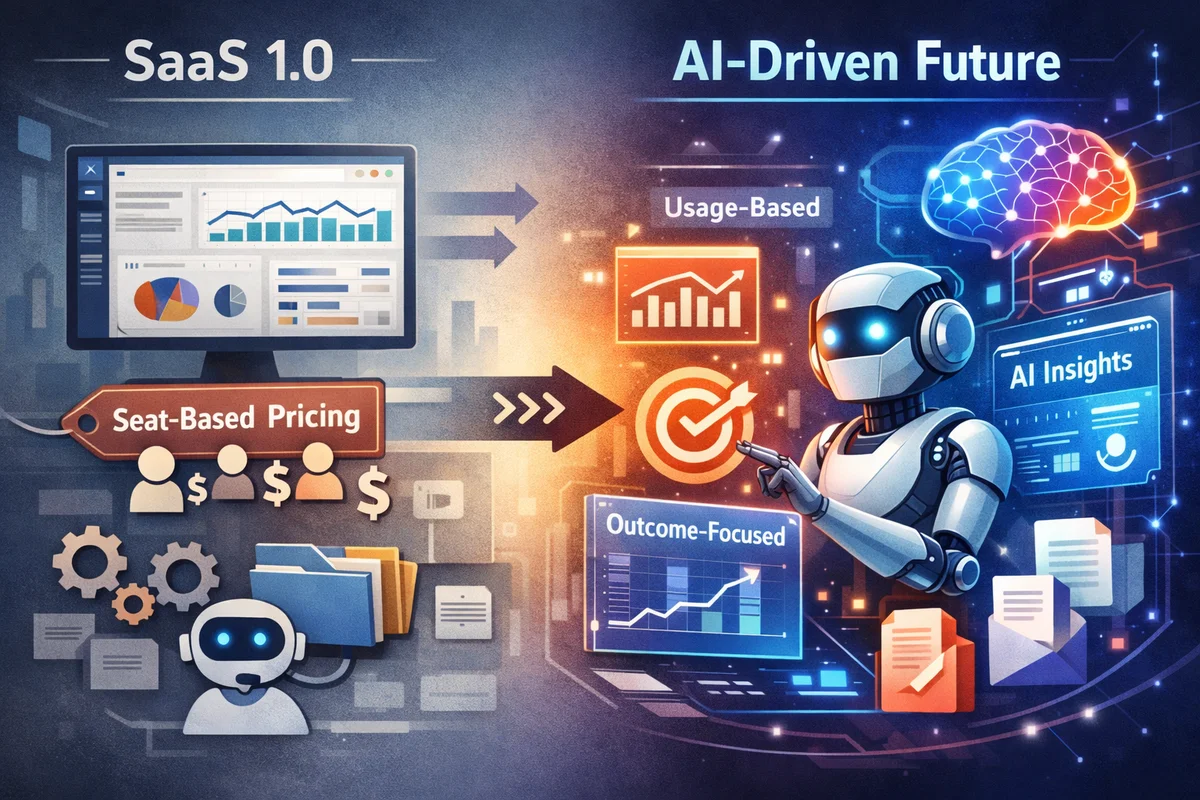
SaaS 1.0 vs SaaS 2.0
SaaS 1.0 was largely about organizing work, centralizing data, and making teams more efficient through software access.
SaaS 2.0 is increasingly about performing work, coordinating humans and agents, and owning outcomes rather than just screens. Microsoft’s “Frontier Firm” framing is useful here: the next generation of companies is organized around human-agent teams, not only human employees using software tools.
That does not mean every interface becomes conversational. It means the best products use whatever interface is necessary, but they do not force the user to be the execution engine for every task.
AI-decorated vs AI-native products
This distinction matters a lot.
An AI-decorated product adds summarization, chat, drafting, or recommendations to an otherwise unchanged workflow.
An AI-native product rethinks the workflow itself around what AI can now do. That usually changes onboarding, task flow, approval logic, escalation, observability, and pricing. Deloitte’s 2026 outlook and Simon-Kucher’s 2026 pricing perspective both imply that AI becomes more embedded and less separable as a paid add-on over time.
The new sources of defensibility
In the classic SaaS era, people often talked about defensibility in terms of feature breadth and switching costs. In the AI era, those matter less on their own.
The stronger moats are increasingly:
proprietary context and data
deep workflow embedding
compliance and governance
distribution
reliability and evaluation systems
integrations into the operational stack
vertical specialization
human-in-the-loop controls
This is partly because model access is becoming less scarce. If everyone can reach strong models, the moat shifts upward into context, workflow depth, and trust. Simon-Kucher’s 2026 trends also call out data as a defining asset, while Deloitte frames the competition as moving toward AI-first, agentic products rather than shallow AI features.
A good example of the pricing side of this defensibility shift is Intercom’s Fin. Instead of monetizing only seats, Intercom prices Fin AI Agent at $0.99 per outcome, charging when the agent resolves the configured task. That model aligns the vendor with the customer’s result, not just software access. It is not the right model for every category, but it is a strong signal of how value capture is changing.
How generative AI changes product design
When AI becomes core to the product, product design changes in three big ways.
One, chat becomes a layer, not the whole product. People still need structured views, controls, audit trails, and approvals. The winning products will usually combine intent-based interaction with purpose-built interfaces, rather than replacing the entire product with a text box. Gartner’s warning against conflating assistants and agents reinforces this point.
Two, users increasingly want outcomes, not copilots. A copilot that merely suggests the next action is weaker than a system that can actually complete the safe parts of the workflow and escalate exceptions. This is why “system of action” matters more than “system of record.”
Three, workflow design becomes adaptive. Instead of fixed menus and static steps, products can now generate task flows dynamically, personalize guidance, and automate segments of the process invisibly. Microsoft’s recent product direction around agent management and custom agents inside work software shows how mainstream this shift has already become.
How generative AI changes business models and pricing
This is where many founders still underestimate the shift.
If AI creates variable costs and reduces labor, then pricing only by seat gets harder to defend. McKinsey says AI is changing software economics by introducing variable costs, and Simon-Kucher says usage-based pricing is becoming the default for many AI packages because seat metrics break when AI does more of the work.
That does not mean every company should rush into pure outcome pricing. In many categories, the realistic answer will be a hybrid model:
platform fee or subscription for baseline access
usage layer for AI-intensive actions
outcome-linked layer where results are measurable and meaningful
Bessemer’s 2026 AI pricing playbook makes a similar argument: AI is increasingly priced more like productive labor than passive software access, which pushes vendors to think in terms of outcomes, not just licenses.
The key strategic point is simple: pricing has to match how value is created. If your product’s main promise is saved labor, faster throughput, or completed work, customers will increasingly expect pricing that reflects that.
What kinds of SaaS products still remain relevant
The most resilient categories tend to share a few traits.
They usually own a critical workflow, especially one tied to revenue, compliance, operations, or high-cost labor. They often serve high-value verticals where domain context matters. They integrate deeply into business systems. They combine AI with proprietary data, controls, and execution. They become systems of action, not just systems of record.
That means strong opportunities still exist in:
vertical SaaS with domain-specific context
AI-native operational software
workflow automation products tied to real systems
compliance-heavy categories
support, finance, legal, health, and operations products where trust and auditability matter
software that owns the execution layer, not just the reporting layer
The fragile categories are not “all SaaS.” They are mostly the ones still built on outdated assumptions about UI dependence, generic workflows, and weak proprietary context.
Common misunderstandings
One common mistake is saying “AI kills all SaaS.” It does not. It compresses some kinds of value while increasing the importance of others.
Another is saying “adding a chatbot makes a product AI-native.” Usually it does not. It often just adds a thin interaction layer on top of an unchanged workflow.
Another is saying “distribution no longer matters because AI can build anything.” That is backward. When products are easier to build, distribution matters even more.
Another is saying “agents replace all software.” In practice, agents still need systems, permissions, observability, and business logic to operate safely. Gartner’s warnings on the limits and failure of many agentic projects by 2027 are a reminder that execution quality and controls matter as much as ambition.
What this means for founders and builders
The big mindset shift is that the question is no longer, “How do I add AI to my SaaS?”
The better questions are:
What work can this product actually perform?
What result can it own?
What proprietary context can it build around?
What happens if the UI matters less than the execution layer?
How should pricing work if AI reduces human effort instead of adding more users?
That is the real move from SaaS 1.0 to SaaS 2.0.
In 2026, the founders with the strongest position are not the ones chasing “AI features.” They are the ones redesigning product logic, workflow depth, and monetization around the reality that software is becoming more agentic, more adaptive, and more outcome-driven. Deloitte, McKinsey, Simon-Kucher, BCG, and Microsoft all point in roughly the same direction from different angles: software value is shifting from access and organization toward execution, productivity, and measurable business impact.
Final takeaway
So, is SaaS dead in 2026? No.
But some SaaS models are getting weaker fast.
The more a product depends on seat expansion, static dashboards, repetitive manual use, generic features, and UI-heavy access as its main value source, the more pressure it will feel.
The SaaS products that remain relevant are the ones evolving into SaaS 2.0: AI-native or AI-deep products that execute workflows, embed into real systems, own proprietary context, and increasingly price around usage, automation value, or outcomes rather than just access. That is the future of SaaS in a generative AI world.
Featured on Flaex