

Loading...

Dasher
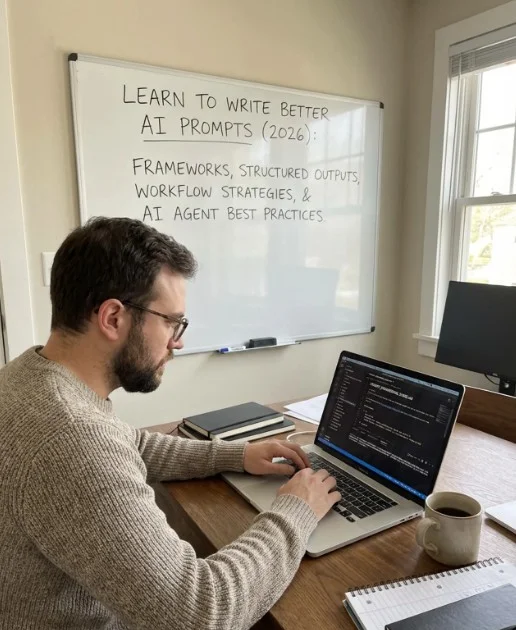
Current guidance from OpenAI emphasizes explicit output contracts, tool-use expectations, grounding rules, and completion criteria, while Anthropic increasingly frames this broader practice as context engineering. Google continues to describe prompt engineering as an iterative process built on objectives, instructions, structure, examples, and testing.
<strong>That shift changes everything.</strong>
A prompt is no longer just a request for text. It is the control layer behind AI writing, research, automation, internal copilots, lead qualification, reporting, and multi-step AI agents. If you want stronger outputs from ChatGPT, Claude, Gemini, or any modern LLM, the quality of your prompt still matters because it shapes how the model interprets the task, what context it uses, when it retrieves information, what boundaries it respects, and what format it returns. (<a target="_blank" rel="noopener noreferrer nofollow" href="https://developers.openai.com/api/docs/guides/prompt-engineering/" title="Prompt engineering | OpenAI API">OpenAI Developers</a>)
This guide breaks down how to write better AI prompts in 2026, which prompt engineering techniques still matter, how to structure prompts for workflows and agents, and what mistakes quietly destroy output quality.<h2>What Is an AI Prompt?</h2>An AI prompt is best understood as an execution brief.
It tells the model what job it is doing, what outcome matters, what context to use, what tools are available, what constraints must be respected, and what kind of answer should come back. <a target="_blank" rel="noopener noreferrer nofollow" href="https://cloud.google.com/discover/what-is-prompt-engineering">Google</a> describes prompt engineering as designing and optimizing prompts by supplying context, instructions, and examples so the model can generate the desired response. OpenAI similarly frames prompt engineering as writing effective instructions that consistently produce outputs aligned with your requirements.
That is why the best prompt is not the shortest prompt.
The best prompt is the one that removes ambiguity without creating noise. It gives the model enough structure to perform well, but not so much clutter that the signal gets buried.<h2>Why Prompt Engineering Still Matters in 2026</h2>Models are better than they were a year ago. They follow instructions more closely, use tools more effectively, and handle longer contexts with more stability. But stronger models do not eliminate the need for prompt engineering. They make good prompting more leverageable.
OpenAI’s current prompting guidance recommends explicit output contracts, tool instructions, completion criteria, and verification loops for stronger multi-step performance. Anthropic’s best-practices documentation covers clarity, examples, structured prompts, thinking, and agentic systems as core levers for better results. Google’s documentation still treats prompting as a test-driven, iterative process rather than a one-shot trick.
In practical terms, good prompts improve five things:<ul><li>relevance</li><li>reliability</li><li>formatting consistency</li><li>tool behavior</li><li>downstream usability</li></ul>That matters whether you are writing a landing page, extracting data into JSON, summarizing a report, or running an AI agent that needs to search, verify, act, and stop safely.<h2>The Anatomy of a High-Performance Prompt</h2>The strongest prompts in 2026 usually combine seven elements:<ol><li>Role</li><li>Goal</li><li>Context</li><li>Tools</li><li>Constraints</li><li>Output format</li><li>Verification</li></ol>This structure aligns well with current guidance across OpenAI, Anthropic, and Google, all of which emphasize clarity, structure, explicit instructions, contextual grounding, and testing. <h3>1. Role</h3>A role tells the model how to orient itself.
It affects vocabulary, decision criteria, depth, and tone. A vague role creates generic output. A concrete role creates more useful output.
Weak:<blockquote>You are an expert AI.</blockquote>Strong:<blockquote>You are a senior SEO strategist writing for startup founders, solo operators, and growth teams.</blockquote>Or:<blockquote>You are a technical operations assistant that creates clean SOPs for internal teams.</blockquote>Anthropic explicitly recommends giving <a target="_blank" rel="noopener noreferrer nofollow" href="https://docs.anthropic.com/en/docs/build-with-claude/prompt-engineering/system-prompts">Claude</a> a role as part of prompt best practices because it helps the model anchor its behavior more consistently. <h3>2. Goal</h3>The goal defines the job to be done.
A strong goal is specific about the deliverable, audience, and result. It should make success obvious.
Weak:<blockquote>Write about AI prompts.</blockquote>Strong:<blockquote>Write a 2,000-word article explaining how to write better AI prompts for LLMs, workflows, and AI agents, aimed at marketers, founders, and AI operators.</blockquote>Specific goals reduce drift. They also make evaluation easier.<h3>3. Context</h3>Context separates average prompts from high-performing prompts.
This is where you give the model the information it would otherwise have to guess:<ul><li>who the audience is</li><li>what the business objective is</li><li>what source material matters</li><li>what terminology to use</li><li>what assumptions to avoid</li><li>what style the output should match</li></ul>Google’s prompt design guidance highlights contextual information and structure as essential prompt components, and Anthropic’s context engineering guidance treats the selection and organization of context as a major performance lever for agents.
Example:<blockquote>Context: This article is for consultants, founders, and AI operators who already use ChatGPT or Claude and want more reliable outputs in workflows and automation systems. The tone should be premium, practical, and authoritative.</blockquote><h3>4. Tools</h3>Modern prompting becomes much more powerful when <a target="_blank" rel="noopener noreferrer nofollow" href="https://www.flaex.ai/">tools are involved</a>.
If the model can search the web, query a CRM, retrieve from internal docs, use a spreadsheet, or call an API, your prompt should explain when those tools should be used and when they should not. OpenAI’s Responses API and agent tooling are built around tool-enabled workflows, while Anthropic’s tooling guidance stresses that agent quality depends heavily on clear tool usage and well-defined tool surfaces.
Example:<blockquote>Use web search when the task depends on current information, regulations, pricing, product details, or anything likely to have changed. Use internal reasoning for synthesis, explanation, and writing.</blockquote>That single instruction often improves factual reliability immediately.<h3>5. Constraints</h3>Constraints create focus.
They tell the model what to avoid, what standard to hit, and what boundaries matter. Useful constraints include tone, length, exclusions, source rules, audience level, banned phrases, and approval requirements.
Example:<blockquote>Constraints:<ul><li>Write in clear premium English.</li><li>Avoid fluff, repetition, and generic claims.</li><li>Do not invent statistics.</li><li>Retrieve uncertain or time-sensitive facts before presenting them as true.</li><li>Ask for confirmation before any irreversible action.</li></ul></blockquote>Constraints are not there to reduce creativity. They are there to reduce failure.<h3>6. Output Format</h3>Output format is one of the most important prompt upgrades in 2026.
If you need consistency, automation, or machine-readability, define the format explicitly. OpenAI’s Structured Outputs guidance is very clear on this point: schemas reduce invalid fields, missing keys, and downstream formatting problems by constraining the model to a defined JSON structure.
Weak:<blockquote>Give me the result.</blockquote>Strong:<blockquote>Return the answer in this structure:<ol><li>Executive summary</li><li>Key insights</li><li>Risks</li><li>Recommended next actions</li><li>Final checklist</li></ol></blockquote>Or, for automation:<blockquote>Return valid JSON with the fields: company_name, intent_score, urgency_level, next_best_action, and confidence_score.</blockquote><h3>7. Verification</h3>A good prompt should define how the model checks its work before it stops.
OpenAI’s current prompt guidance emphasizes completion criteria and verification loops for multi-step tasks, especially in <a target="_blank" rel="noopener noreferrer nofollow" href="https://www.flaex.ai/ai-build-stack">agentic workflows</a>.
Example:<blockquote>Before finalizing, verify that all required sections are included, unsupported claims have been removed, and the output matches the requested format.</blockquote>This is one of the simplest ways to improve consistency without making the prompt dramatically longer.<h2>The Best AI Prompt Framework to Use in 2026</h2>A reliable all-purpose formula looks like this:
<strong>Role + Goal + Context + Tools + Constraints + Output Format + Verification</strong>
Here is a reusable prompt template:<pre><code class="language-text">You are [role].
Your objective is to [goal].
Context: [audience, business context, definitions, source material, relevant background]
Available tools: [list tools and explain when to use each one]
Constraints:
Output format: [exact sections, schema, structure, or file format]
Before finalizing:
It works best for tasks the model already understands well, such as summarization, rewriting, translation, or explanation.
Example:<pre><code class="language-text">Summarize this report in five bullet points for a non-technical executive audience. </code></pre><h3>One-shot prompting</h3>One-shot prompting provides one example of the desired transformation.
This is useful when tone, structure, or framing matters.
Example:<pre><code class="language-text">Rewrite product descriptions in this style:
Input: "A lightweight laptop with 16GB RAM and 512GB SSD." Output: "A fast, portable laptop built for professionals who need speed, multitasking, and reliable storage on the go."
Now rewrite: Input: "A wireless noise-canceling headset with 30-hour battery life." </code></pre><h3>Few-shot prompting</h3>Few-shot prompting adds multiple examples before the real task.
Google’s prompt strategy documentation explicitly highlights instructions, examples, and structure as important parts of prompt quality, and Anthropic also includes examples as a core best practice.
Example:<pre><code class="language-text">Classify each lead as Hot, Warm, or Cold.
Examples: Lead: "We need a demo next week. Budget is approved." Category: Hot
Lead: "We are researching options for Q4." Category: Warm
Lead: "Just send pricing." Category: Cold
Now classify: Lead: "We are comparing vendors and want implementation details this month." </code></pre>Few-shot prompting is especially strong for classification, extraction, support workflows, moderation, and brand voice alignment.<h3>Chain-of-thought prompting</h3>In practical production use, chain-of-thought prompting is less about asking for hidden reasoning and more about asking for visible intermediate structure.
For example:<pre><code class="language-text">Analyze this business problem in four steps:
It does not just define expertise. It defines perspective and communication style.
Example:<pre><code class="language-text">You are a sharp, detail-oriented B2B SEO strategist writing for CMOs and growth leaders. Your style is concise, authoritative, and practical. Write a homepage headline and subheadline for an AI analytics platform. </code></pre><h3>Prompt chaining</h3>Prompt chaining breaks one large task into several smaller prompts.
Google’s prompt strategy guidance explicitly recommends breaking down complex tasks, and modern agent systems frequently rely on exactly this kind of staged orchestration.
A simple chain might look like this:<ol><li>Extract the facts</li><li>Organize the facts</li><li>Draft the output</li><li>Review for gaps</li><li>Convert into final format</li></ol>Prompt chaining is excellent for long-form content, audits, research, and data processing.<h2>How to Write Prompts for AI Workflows and <a target="_blank" rel="noopener noreferrer nofollow" href="https://www.flaex.ai/ai-agents">AI Agents</a></h2>This is where prompt engineering becomes operational.
AI agents are not just chat interfaces. They are systems that combine models, tools, context or memory, and orchestration. OpenAI describes agents as systems that independently accomplish tasks on behalf of users, and Anthropic’s agent guidance similarly focuses on tool use, context management, and harness design.
That means an agent prompt should answer questions like:<ul><li>What tools are available?</li><li>When should the agent use them?</li><li>What actions require confirmation?</li><li>What counts as complete?</li><li>What should happen if data is missing?</li><li>How should the output be verified before action?</li></ul>A good agent prompt might look like this:<pre><code class="language-text">You are an AI research and execution assistant.
Your job is to complete the user's request thoroughly and accurately.
Use web search for current facts, regulations, pricing, or product details. Use internal reasoning for synthesis, explanation, and drafting. Do not guess when a retrievable fact is missing. If an external claim matters, verify it before presenting it as fact. Return the result in the requested format. Before finalizing, confirm that all requirements have been completed. Ask for confirmation before any high-impact or irreversible action. </code></pre>That is not just a writing prompt. It is a behavioral contract.<h2>Why Tool Descriptions Matter More Than Most Teams Realize</h2>A tool description is part of the prompt.
Anthropic’s tooling guidance makes this very clear: agents perform better when tools are self-contained, robust, clearly scoped, and paired with descriptive, unambiguous parameters. OpenAI’s function-calling and structured-output ecosystem also relies on explicit schemas and clear interfaces so models know what action to take and how to format the request correctly.
If an AI agent keeps misusing a CRM lookup tool, querying the wrong field, or choosing the wrong action, the problem is often not the model. The problem is weak tool design, vague descriptions, or overlapping functions.
Clear tools produce clearer behavior.<h2>Common Prompt Mistakes That Kill Performance</h2>Most bad prompts fail for predictable reasons.<h3>1. The goal is too vague</h3>If the model does not know what success looks like, it fills the gap with generic language.<h3>2. The context is bloated</h3>More context is not always better. Irrelevant context creates noise and weakens instruction priority.<h3>3. The format is undefined</h3>If you do not define the shape of the answer, you should expect inconsistency.<h3>4. The model is allowed to guess current facts</h3>For time-sensitive topics, retrieval beats memory.<h3>5. Creative and factual tasks are mixed carelessly</h3>Creative writing needs freedom. Factual workflows need grounding. Combining both without clear rules creates unstable output.<h3>6. Tool permissions are unclear</h3>If you do not define when a tool should be used, the model may overuse it, underuse it, or choose the wrong one.<h3>7. There is no safety boundary</h3>OpenAI’s safety guidance for agents warns that prompt injections remain a common and dangerous risk in agent workflows, especially when untrusted content enters the system. The same guidance recommends structured outputs, clear documentation, examples, and caution around privileged instructions and tool access.<h2>Best AI Prompt Examples for 2026</h2>Below are three prompt examples that align with modern search intent around best AI prompts, prompt engineering, structured outputs, and AI agents.<h3>Example 1: SEO content prompt</h3><pre><code class="language-text">You are a senior SEO content strategist writing for founders, creators, and growth teams.
Your objective is to write a 2,000-word article titled: "How to Write Better AI Prompts in 2026"
Context: The audience already uses ChatGPT, Claude, or Gemini. They want practical guidance for prompting LLMs, workflows, and AI agents. The tone should be premium, clear, practical, and authoritative.
Available tools: Use web search if a claim depends on current documentation, recent platform capabilities, or recent best practices. Use internal reasoning for synthesis, examples, and editorial structure.
Constraints:
Output format:
Before finalizing:
Your objective is to analyze a market category and return an executive-ready brief.
Use web search for current facts, market data, pricing, competitors, and regulations. Do not present outdated or uncertain facts as confirmed. Cite every major factual claim.
Return the answer in this structure:
Before finalizing:
Your objective is to review inbound lead data and recommend the next best action.
Available tools:
Constraints:
Output format: Return valid JSON with: company_name, lead_status, intent_score, urgency_level, qualification_reason, next_best_action, confidence_score
Before finalizing:
A strong prompt tells the model who it is, what it must achieve, what information matters, what tools it can use, what constraints it must follow, what format it must return and how it should verify the result before it stops. That is true whether you are prompting <strong>ChatGPT for writing, Claude for research, Gemini for workflow support, or an AI agent</strong> that needs to reason and act across systems.
Prompt engineering is still one of the highest-leverage skills in modern AI.
Not because models are weak.
Because the teams that write better instructions get better outcomes.